Where our energy money actually goes
Research by Carl Fitzsimmons with references
What the 130th could gain by keeping it here.
Billions in public dollars now flow to nuclear plant owners posting record profits, including the owner of Ginna in Wayne County.
The same money, invested in a mix of publicly owned solar, wind, hydro, geothermal, farm digesters and battery storage, delivers power in two years instead of twenty, at a fraction of the cost, with the savings landing on Wayne County and Webster bills instead of shareholder statements 200 miles away or in another country.
Every figure below is footnoted to a public source. Read it, check it, and share it.
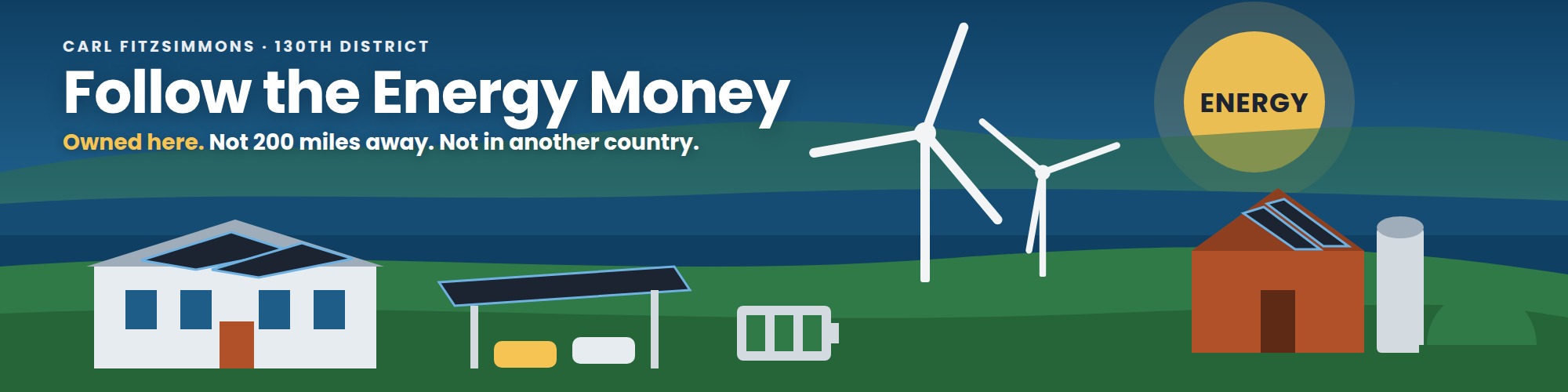
Follow the Energy Money
California is spending billions in public money to keep one nuclear plant running while its utility posts record profits. New York is doing the same thing with a plant in our own county. Here is what that money buys, what it could buy instead, and why publicly owned solar, wind, biomass, geothermal, hydro, and storage are the faster, cleaner deal for the 130th.
Ratepayers in California have already been billed more than $1.1 billion in two years for Diablo Canyon, on top of a $1.4 billion state loan that may never be repaid, while PG&E earned $2.59 billion in 2025. New Yorkers have paid about $4 billion since 2017 in nuclear surcharges to Constellation Energy — the owner of Ginna in Ontario, NY — and Albany just extended that program to 2049 at a cost of up to $33 billion. Constellation made $2.3 billion in 2025 and is buying back $5 billion of its own stock.
The same dollars, invested in generation the public owns, buy power in 12 to 24 months instead of 10 to 15 years, at a third to a fifth of the cost of new nuclear, with the savings going to your bill instead of a shareholder — and with no radioactive fuel casks for our grandchildren to guard.
1. California's Diablo Canyon: the ledger
In 2022 California decided to keep PG&E's Diablo Canyon plant running past its planned 2025 retirement. The bill has come due in three places: the U.S. Treasury, the state general fund, and every utility customer in California — including customers of two other utilities who get nothing from the plant.
| Who pays | What | Amount |
|---|---|---|
| Federal taxpayers | DOE Civil Nuclear Credit award (ceiling $1.1B; $741.4M guaranteed base). First payment of $271M made Aug 14, 2026.1 2 | up to $1.1B |
| State taxpayers | Zero-interest, forgivable loan (SB 846). Repayable only from federal credits or final-year plant profits; CalMatters projects up to $588M (42%) forgiven; Sen. Laird puts the unpaid balance near $650M. TURN's Matthew Freedman: "It's not a loan. It's a gift."3 4 | $1.4B |
| Ratepayers (2025) | CPUC-approved above-market costs, Dec 20245 | $722.6M |
| Ratepayers (2026) | CPUC-approved above-market costs, Dec 20256 | $382M |
| Ratepayers (2027, pending) | PG&E request filed Mar 2026: $340M PG&E, $208M SCE, $47M SDG&E7 | $595M |
| Ratepayers (every year) | "Volumetric performance fee," $13/MWh written into law, replaces PG&E's shareholder return. 2026: $190.8M PG&E + $59.7M SCE + $12.9M SDG&E customers. CalMatters: a potential "slush fund" with thin oversight.8 | ~$263M / yr |
| PG&E's own filing: total customer-funded cost of running the plant, 2024–20309 | $7.2B | |
A UC Santa Barbara analysis (April 2026) concludes PG&E "significantly inflated" its costs: DOE found the plant needed $741.4M, yet PG&E sought $1.1B federally and $1.4B from the state, and is collecting ~$2.65B in fees above cost through 2030. PG&E calls the report "false." An MIT study argues extending the plant to 2045 would save $7.6–20B versus alternatives. The economics are contested; the public money is not. Federal taxpayers, state taxpayers and ratepayers cover the costs; PG&E's shareholders keep the profit — the gains privatized, the losses socialized. The industry has a polite term for it — cost externalization: make someone else pay for what you don't want to cover.10 11
2. New York's version: Zero-Emission Credits and Ginna
New York got here first. In 2016 the Public Service Commission created "Zero-Emission Credits" — a surcharge on every electric bill in the state, paid to the owner of the four upstate reactors: Ginna in Ontario (Wayne County), FitzPatrick, and Nine Mile Point 1 and 2. All four now belong to Constellation Energy.16
| Item | Detail | Amount |
|---|---|---|
| ZEC 1.0 (2017–2029) | Original 12-year program cost approved by the PSC17 | ~$7.6B |
| Paid so far | Charged to New York ratepayers since April 201717 | ~$4B |
| Current cost | Per year, after federal tax-credit offsets (PSC, Jan 2026)16 | ~$408M / yr |
| ZEC 2.0 (2029–2049) | Extension approved Jan 22, 2026. Credit price starts at $36.27/MWh in 2029 and rises to $82.75/MWh by 2048–49. PSC says actual cost is "likely less than half" the maximum.18 19 | up to $33.4B |
| New nuclear | Gov. Hochul's 5 GW "Nuclear Reliability Backbone." State's own options paper: public support needed over the first 25 years; projects need above-market revenue of $183–452/MWh. Wayne County has pitched itself as a host site.20 21 | $15.4–23.9B |
For scale: NYSERDA's most recent large-scale solar and wind contracts came in at a weighted average of $94.73/MWh — all-in, for the whole product. ZEC 2.0 will pay up to $82.75/MWh on top of the market price of the power.22 18
Ginna has been bailed out before
Wayne County ratepayers have seen this movie. In 2014, with low-cost natural gas undercutting it, Ginna's owner (then Exelon) said the plant had lost more than $100 million since 2012 and would close unless RG&E customers paid to keep it open. The utility asked for $17.5 million a month; the PSC-approved "Reliability Support Services Agreement" settled at roughly $15 million a month — about $175 million a year — paid by RG&E customers from April 2015 to March 2017, adding about 4% to a residential bill and 1.5–9% to businesses. NYISO then found the grid didn't need Ginna past March 2017; the payments ended only because the statewide ZEC surcharge took over the next month.124 Twice in a decade, the same plant, the same argument, the same payer. When the plant loses money the public covers it; when it makes money the owner keeps it. This is the market privatizing the gains and socializing the losses.
What Ginna means here
Ginna is a 580 MW plant with about 357 direct jobs and a 10-year PILOT agreement worth $51.5 million total to Wayne Central schools, the county, and the Town of Ontario — an agreement that steps down from $7.5M a year in 2019–20 to $2.25M in 2028–29.27 28 Its federal license expires in September 2029; Constellation has applied to run it to 2049, and said that depends on the ZEC extension.29 Nothing in this brief proposes shutting Ginna down tomorrow. The question is where the next public dollar goes — and whether it should go to a company that just told Wall Street it expects "combined market plus ZEC revenue" of $115.75 per MWh by 2049.24
3. Long-term cost: nuclear vs. solar, side by side
Lazard's annual levelized-cost study is the industry's standard yardstick. Unsubsidized, in dollars per megawatt-hour, for plants built today:30 31
Bar length shows the top of each range. Lazard LCOE+ v19, July 2026. Existing, already-paid-for nuclear runs at a marginal cost of about $30–38/MWh — which is why the ZEC subsidy on top of market price is so lucrative.31
The one new nuclear plant America has actually finished this century is the benchmark: Vogtle 3 & 4 in Georgia was estimated at $14 billion in 2008 and finished in 2024 at about $35 billion, seven years late — roughly $15,000 per kilowatt. Georgia Power customers pay about $14.39 more per month for it.32 33 Utility-scale solar installed in 2024 cost about $1,600–1,900 per kilowatt; onshore wind about $1,900; a four-hour battery about $1,340.34 35
Solar's true cost includes a lower capacity factor — in New York, about 17–19% versus Ginna's 94–99% — so the honest per-kilowatt-hour comparison favors solar by a smaller margin than the per-kilowatt one. That is what Lazard's numbers above already account for, and new nuclear still costs two to four times as much per unit of energy.36 21
4. Speed and cleanliness
- Vogtle: 16 years from application to power.32
- NYPA has not yet chosen a site, a reactor design, or a partner for Hochul's plan; the state's own paper says the last of the 5 GW "would likely only just have come online" by 2050.37 20 (Not to be confused with Fort Drum: on Aug 26, 2026 the U.S. Army — not NYPA — chose Fort Drum for a 1–20 MW Janus Program microreactor, built by Westinghouse Government Services; that is about 1–3% the size of Ginna and separate from the state plan.77)
- Spent fuel: Ginna holds roughly 500 metric tons on site, in a pool and on a dry-cask pad licensed for 24 casks. Diablo Canyon: 58 casks, room for 140.38 39 40
- There is no permanent repository. Congress picked Yucca Mountain, Nevada, in 1987; after nearly $15 billion in studies and tunnels, the federal government cut off its funding and withdrew the license application in 2010. It has sat inactive ever since, and no waste has ever been stored there.41
- Casks are certified for 40 years and renewed in 40-year increments with no upper limit; the NRC's own planning scenarios include a repository arriving 160 years from now — or never.42 43
- Because the government promised to take the fuel in 1998 and hasn't, taxpayers have already paid utilities $12.2 billion in damages, with $38.6–44.3 billion more projected.44
- A closed plant with nothing left but casks (Maine Yankee) costs about $10M a year to guard and maintain.45
- NextEra, the largest U.S. renewables builder: wind in 12 months, storage in 15, solar in 18.46
- NYSERDA's May 2025 contract round: 26 projects, 2.5 GW, 670,000 homes, $6B private investment, 1,900 jobs, all online by 2029.47
- Panels last 25–35 years; 1980s panels are still producing. End-of-life panels are ordinary solid waste (some fail lead/cadmium tests and are handled as hazardous) — not radioactive, and recyclable through SEIA's national program.48 49
- No fuel to buy, no fuel to guard, no century-long federal liability.
- The remaining honest constraint is the grid queue: NYISO's reformed cluster study takes about 20 months. That is a permitting problem Albany can fix — not a physics problem.50
Paid twice for the same fuel
Here is how the waste bill lands on taxpayers. The industry supported the Nuclear Waste Policy Act of 1982, a bipartisan bill signed by President Reagan, which made the federal government responsible for taking every utility's spent fuel starting January 31, 1998. In return, utilities collected a fee from their customers and paid it into a federal Nuclear Waste Fund — which now holds about $49.5 billion of ratepayer money.125 126 When 1998 came and no repository existed, the same companies sued the government for breach of contract and won. But the courts also ruled that the Waste Fund can be spent only on building a repository, so the damages come instead from the U.S. Treasury's Judgment Fund — ordinary taxpayer money: $12.2 billion paid so far, $500–800 million more every year, and $38–45 billion projected as long as the fuel sits where it is.44 127 Ratepayers paid once into a fund that can't be touched; taxpayers pay again, every year, for the same casks — and every new reactor adds to a pile that has no destination. That is the contract the nuclear industry wrote, and it is why "the government will take the waste" should never again be accepted as an answer. In the industry this has a name: cost externalization — make someone else pay for what you don't want to cover. It is another form of privatizing the gains and socializing the losses. This is the market privatizing the gains and socializing the losses.
5. What that money could do instead
Installed capital cost is the fairest way to answer "what could we buy?" Using 2024–2026 U.S. installed costs and New York capacity factors, each $1 billion of public money buys, outright and owned by the public:34 35 51 52 53 54
| Technology | $1B buys (installed) | Output / effect per year | Basis |
|---|---|---|---|
| Solar (utility-scale) | ~620 MW | ~970 GWh — enough for ~130,000 upstate homes | $1.6M/MW, 17.7% CF |
| Onshore wind | ~530 MW | ~1,150 GWh — ~155,000 homes | $1.9M/MW, 25% CF |
| Battery storage (4-hr) | ~750 MW / 3,000 MWh | Half of NY's entire 2030 bulk-storage target, from one year of ZECs plus change | $1,336/kW |
| Geothermal — heat pumps (the right use here) | ~55,000 homes converted | Cuts each home's heating and cooling cost and gas use; NYS Clean Heat pays $17k per RG&E/NYSEG retrofit | $17k–18k/home |
| Geothermal — power (enhanced) | ~150–180 MW | ~900–1,000 GWh, runs around the clock; Fervo is building at $5,500–7,000/kW in Utah, first power late 2026 | $5.5–7k/kW, 65% CF |
| Biomass / RNG digesters | ~50 dairy digesters | Each $20M digester powers ~500 homes and cuts farm methane; NY's achievable RNG potential is ~90 trillion Btu/yr, ~7% of state gas use | $20M/farm |
| Hydro upgrades | One "Next Generation Niagara" | NYPA's $1.1B modernization of 2,600 MW; Blenheim-Gilboa's $135M rebuild added 120 MW. NYPA hydro sells at about 1¢/kWh. | NYPA programs |
Home equivalents use 7,500 kWh/yr. Capacity factors are New York's (NYISO), not national averages. Geothermal power figures assume enhanced-geothermal costs; New York has no conventional hot-spring resource, and the Cornell Earth Source Heat borehole is the state's leading deep-heat test. In the 130th, geothermal's best use is heating and cooling — ground-source heat pumps that cut a home's or school's HVAC bill — rather than power generation; the power row is shown for completeness.55
Applied to the actual sums of nuclear money
| The nuclear money | Amount | Buys instead (solar, unless noted) |
|---|---|---|
| One year of NY ZECs | $408M | ~255 MW of public solar every year — ~400 GWh/yr added annually, owned forever |
| NY ZECs paid to date | $4B | ~2,500 MW of solar producing ~3,900 GWh/yr — about 80% of Ginna's annual output, with no fuel, no casks, and no 2049 payment schedule. Or 12,000 MWh of batteries — twice NY's 2030 target. |
| ZEC 2.0, PSC's "likely" case | ~$16B | ~10,000 MW of solar — more than doubling everything New York has installed in 20 years — or ~8,400 MW of wind |
| ZEC 2.0, maximum | $33.4B | ~21,000 MW of solar, or the whole 5 GW nuclear "backbone" delivered as 5 GW of wind plus 5 GW of solar plus 6 GW of 4-hour storage — with ~$10B left over |
| New-nuclear public support (state paper) | $15.4–23.9B | ~9,600–15,000 MW of solar, online by 2030 instead of 2040–2050 |
| Diablo Canyon customer cost, 2024–30 | $7.2B | ~4,500 MW of public solar for California |
Arithmetic: each sum of money ÷ the cost to build one megawatt. Example: $408M ÷ $1.6M per MW ≈ 255 MW. Solar at $1.6M/MW, wind $1.9M/MW, storage $1.336M/MW (4-hr). NY installed solar was 8,226 MWdc as of Sept 2026.56 Solar and wind output is variable; the point of pairing them with storage and hydro is firmness — see the objections below.
The battery race we are losing
Storage is what turns cost-effective solar into round-the-clock power, and it is the fastest-growing energy market on earth. Stationary storage was a $67 billion global market in 2025 and is projected to reach $526 billion by 2035.57 China built "well over 80%" of the world's batteries last year; the United States has about 5% of global cell capacity.58 59 In 2025, for the first time, more U.S. battery-factory investment was cancelled ($11B) than announced ($8B), after Washington rolled back the manufacturing credits and stacked tariffs of up to 156% on Chinese cells.59 Chinese storage makers shipped 298 GWh of orders overseas in the first half of 2026 — up 83% — while North American orders collapsed to about 5 GWh.60 Every public dollar New York routes into nuclear credits for a company buying back its own stock is a dollar not building the storage, solar, and manufacturing jobs that the rest of the world is racing to build.
Batteries belong at more than the substation. Put them in homes, on farms, in schools and in town and county buildings, and a distributed system does two things a central plant can't: it keeps the lights, the well pump and the furnace running for the hours or days after an ice storm or a lake-effect blizzard takes the lines down, and it builds the local market for a product the whole world is racing to make. Every public dollar we route into nuclear credits is a dollar not spent creating the demand that brings that manufacturing here. America designing and building those batteries — and leading the world in it — is what keeps America great. As John F. Kennedy put it in 1962: we do these things "not because they are easy, but because they are hard."
6. Why public ownership is the point
The Diablo Canyon and ZEC stories have one thing in common: the public takes the risk and the shareholders take the return — the gains privatized, the losses socialized. Anyone who calls public power "socialism" should look at who has been paying the nuclear industry's bills for forty years: every taxpayer, so a very few can capitalize. Public power flips that: the public takes the risk and keeps the return.
Fairport's advantage isn't magic: it buys NYPA hydropower at about a penny a kilowatt-hour and charges a flat $4.67 delivery fee, while RG&E — now a subsidiary of Spain's Iberdrola, which earned €6.3 billion in 2025 — charges $22 a month plus 5.3¢/kWh for delivery, and is asking the PSC for a 26% electric increase ($33/month).61 64 65 The PSC fined RG&E $8 million this year for failing customer-service standards two years running, and its 2025 management audit found the company couldn't reliably say which of its 13 affiliates costs were going to.66 67
New York already has the tool. The Build Public Renewables Act (2023) directs NYPA to build and own renewables; NYPA has a 5.5 GW plan and $1.2 billion allocated through 2029, with output from its first solar project going straight to low-income bill credits.68 69 The shortfall is money and urgency: as of July 2026, not one BPRA project had broken ground.70 A single year of ZEC money would triple NYPA's renewables budget — and that record is exactly why the money has to come with a mandate: build it here, and own or contract it here.
Locally, solar means PILOT payments to towns and schools ($1,700–5,000 per MW per year is the NYSERDA benchmark in RG&E territory), lease income that keeps family farms in the family, and — when the array is publicly owned — power sold to residents at cost. Wayne County's IDA has already approved a 5 MW farm in Arcadia; Walworth is reviewing another. Cornell finds 84% of New York's solar-suitable land is farmland, and that sheep grazing, berries, and leafy greens work under panels.71 72 73
Who really took the money
For forty years we have been told who is taking our money: the immigrant, the family on assistance, the neighbor who won't work. Look at the receipts on this page instead. The nuclear bailouts alone — $4 billion in surcharges, $12 billion in taxpayer damages, a $1.4 billion "gift" in California, $175 million a year for Ginna — went to a handful of multinational corporations posting record profits. The same pattern runs through our health care bills: a New York family now pays $27,188 a year for employer coverage, the highest in the country, while UnitedHealth made $19 billion in operating earnings last year and Webster's school health plan was told its premium could jump more than 50% — a cost that lands straight on the property-tax levy.128 129 130 That is where the money went. It was never the people we were told to resent; it was the corporations and the politicians they pay for, pointing at someone else while their own hands were in the cookie jar. Private gains, public losses, and a story about who to blame so we would look the other way. Stop listening to the story. Follow the money.
7. What the other side will say
True, and it's why this brief pairs solar with storage, wind, and New York's 4,200 MW of public hydro. Solar-plus-storage costs $61–156/MWh today — still well under new nuclear's $175–255 — and stationary battery prices fell 45% in 2025 alone. New York's own roadmap calls for 6 GW of storage by 2030; one year of ZEC money buys half the bulk-storage target. MIT's Buongiorno argues 20–30% nuclear lowers total system cost; that is an argument for keeping the reactors we have running at market price, not for writing a 20-year blank check.30 74 75 33
No. Ginna's license runs to 2029 and Constellation is applying to extend it. Existing nuclear runs at $30–38/MWh — it can compete. The objection is to paying a company earning $2.3 billion a year an extra $36–83 per MWh through 2049, and to committing $15–24 billion of public money to new reactors that won't produce power until the 2040s.31 18 20
All 5,000 MW in NYSERDA's solar study would cover about 23,000 acres — under 0.1% of New York's 30 million acres — and much of it can stay in agricultural use. Meanwhile New York lost 364,000 farm acres between 2017 and 2022 to economics, not solar. A $1,200-an-acre lease is what keeps a farm from becoming a subdivision.76 63 73
It does — ordinary industrial waste, recyclable, with a 25–35-year life. It does not require armed guards, a federal trust fund, or a repository that, nearly 40 years and $15 billion after Congress chose the site, still does not exist.48 41
The jobs are real, and so is the fine print. Wayne County's administrator has cited "at least 500 jobs per facility"; a Spectrum report put a proposed plant at 1,600 construction and 1,200 permanent jobs — a permanent figure with no precedent anywhere in the industry.78 The only large reactors America has actually built this century, Vogtle 3 & 4, peaked at about 9,000 construction workers over a 15-year build and left 800 permanent jobs for 2,228 MW — roughly 360 permanent jobs per 1,000 MW. The industry's own trade group says a plant employs 500–800 people and a big build peaks at up to 4,500.79 80 Advanced-reactor projects now under way run smaller: TerraPower's Wyoming plant, 1,600 construction and 250 permanent; X-energy's Washington site, 1,000 and "more than 100."81 For NYPA's plan, neither NYPA nor the state's options paper has published a job number at all.37 20
What that money creates instead, using the same public dollars through NYPA (which by law must use prevailing wage, project labor agreements, and apprenticeships on every renewable project it builds):82
| Per $1 billion of public money | Construction jobs | Permanent jobs | When |
|---|---|---|---|
| New nuclear (state paper: $15.4–23.9B for 5 GW) | ~4,000 at peak per 1,000 MW, spread over a 7–15 year build; mostly traveling specialty trades | ~360–500 per 1,000 MW, for 60–80 years | Construction 2030s; plant jobs 2040s |
| Solar, ~620 MW | ~1,300–2,200 job-years, in 12–24 months | ~60–220 (O&M) | 2028 |
| Onshore wind, ~530 MW | ~1,600–2,100 job-years | ~70–210 technicians (median pay $64k, fastest-growing job in the U.S.) | 2028 |
| Geothermal power, ~150–180 MW (elsewhere; here the payoff is heat pumps) | ~500 job-years (drilling-heavy) | ~110–210 — the highest permanent staffing per MW of any renewable | 2029–30 |
| Farm digesters, ~50 plants | ~300–500 job-years (est.) | Up to 4 per MW — half at the plant, half in manure and feedstock hauling; plus farm income | 2028 |
| Geothermal heat pumps, ~55,000 homes | ~700 drillers, plumbers and HVAC installers for five years (est.) | Ongoing service trade; local, non-exportable | Now |
| Hydro upgrades / storage | Modest: a $1.1B Niagara rebuild employs hundreds for years; a battery site ~100–200 for a year | Small (<5 per site) | 2027–28 |
| Hydro power (small hydro & upgrades) | Hundreds of job-years per modernization; Potsdam's 1 MW rebuild is the New York model | ~0.27 job-years per GWh — nearly double nuclear; New York already employs 5,242 people in hydro83 62 | 2027–28 |
Per unit of energy delivered, the peer-reviewed comparison is solar 0.87 job-years per GWh, geothermal 0.25, biomass 0.21, wind 0.17, nuclear 0.14 — solar creates about six times the jobs per kilowatt-hour.62 Two honest caveats: nuclear jobs pay more (median 52% above other generation) and are more often union (19% vs 13% in solar) — which is exactly why public ownership under the BPRA's labor rules matters — and Ginna's existing ~360 jobs plus the 900 outage workers every 18 months are not on the table in this brief.79 84 27 Bottom line: for the same money, publicly owned renewables put several times more Wayne County residents to work, starting in two years instead of twenty, and the PILOTs to Wayne schools start with them.
Public energy development is already on the platform. What it means in practice is a distributed energy solution: instead of one $20-billion plant owned by a corporation or a state authority two hundred miles away, hundreds of smaller generators owned right here — solar on school roofs, town halls, barns and water plants; community solar arrays our neighbors subscribe to; digesters on our dairy farms; batteries at the substation, in our homes, on our farms, in our schools and in our town and county buildings; heat pumps in our basements. NYPA is the builder and the bank: it has the bonds, the legal mandate, and the prevailing-wage and apprenticeship rules already written into law. But what NYPA finances in the 130th should be owned or contracted here — by our towns, our school districts, co-ops, and municipal utilities like Fairport — so the savings land on Wayne County bills instead of in the wholesale market or an Iberdrola annual report. Distributed generation also keeps the lights on when an ice storm off the lake takes down the lines, and it puts the money in local hands: rooftop and community solar employ about ten times as many people per megawatt as a utility-scale field.85 We were told the immigrant took your money, the family on food stamps, the guy who won't work. Look at the receipts: billions went to corporations posting record profits, and they pointed at your neighbor while they did it. Follow the money — then bring it home.
In parallel: buy the wires. Generation the public owns still pays RG&E to deliver it unless the public owns the poles and wires too. Massena did exactly that: after three referendums (2-to-1, then 3-to-1, then 5-to-1), a $10 million bond and seven years of court fights with Niagara Mohawk, the town took over its distribution system in May 1981. Rates fell 24% the day it switched on; today Massena residents pay about 4¢ per kilowatt-hour all-in against roughly 15¢ next door, and in the 1998 ice storm Massena was back in two days while the investor-owned utility took three weeks.86 Rochester's attempt to even study the idea died in the county legislature for want of $1 million.87 Massena's own counsel warns it "is not a snap" — the utility will fight — which is exactly what an Assembly seat is for: state funding for municipalization feasibility studies in Webster and Wayne County, a fair PSC-set price for the wires instead of a decade of litigation, and NYPA hydro allocations for any town that takes the step.
8. The rest of the plan — and the work to get it done
Let every resident produce — and get paid
Right now a Wayne County homeowner, farm or school that wants to make more power than it uses runs into a wall of rules the utilities asked for. New York caps a home system at 25 kW and a farm system on a residential meter at 100 kW.88 NY-Sun, the state incentive program nearly every installer uses, will not fund a home system sized above 110% of last year's usage — build bigger and you lose the rebate.89 Since 2022 every new rooftop system pays a Customer Benefit Contribution of $1.31 per kW every month in RG&E territory — about $126 a year on a typical 8 kW roof — a charge the PSC adopted after the utilities argued that solar owners shift costs onto their neighbors.9091 And the credits you earn for extra power never turn into money: under today's rules they roll forward for twenty years and expire; under the old rules you were paid once a year at the wholesale price, a few cents.9288 The message from Albany is: make enough for yourself, and not a watt more.
Other states treat a resident's surplus as a product worth buying. Massachusetts pays solar owners for every kilowatt-hour they generate, not just the surplus, for 20 years on top of net metering; its first-round rate was 31–34¢/kWh, worth about $1,500 a year to a typical home, with a 6¢ bonus for farms that keep growing under the panels.9697 Rhode Island runs a feed-in tariff that mails small producers a check at 31.55¢/kWh for 15 years.102 Connecticut lets a homeowner sell all their output at a fixed 32.9¢/kWh for 20 years.103 Vermont pays dairy farms 8¢/kWh for digester power through Green Mountain Power's Cow Power and up to 19.9¢/kWh under its farm-methane standard offer.104 Colorado raised its sizing cap from 120% to 200% of usage in 2021 so families could size for the EV and heat pump they'll buy next; Minnesota allows 120%.105106 New York's own numbers show what's possible: Avon Central School District's 1.5 MW array saves about $64,000 a year.107
The savings elsewhere are not theoretical. Massachusetts towns that buy power together through municipal aggregation have beaten the utility's default rate 79% of the time, saving $138–165 per household per year — Boston alone credits its program with about $200 per resident per year and $260 million since 2021.9899 Massachusetts' 52 publicly owned municipal light plants typically charge about half the investor-owned rate: Belmont Light bills 11¢/kWh against Eversource's 25.8¢.100 And its Green Communities program has put more than $191 million into 298 towns for efficiency and local generation.101
How to make it better in New York. Amend Public Service Law §66-j to bar any usage-based sizing cap and raise the residential limit so a family can build for the electric car and heat pump they will own in 2030 (Colorado's 200% rule). Exempt systems of 25 kW and under from the Customer Benefit Contribution. Pay out surplus credits at the retail or Value-Stack price instead of letting them expire — S1553, which passed the Senate 52–3 in April, is the vehicle and needs an Assembly sponsor to strengthen it.93 Create a New York feed-in tariff on the Rhode Island model so a farm, a school district or a homeowner with a big south roof can sell surplus power under a 15-to-20-year contract, and let a farm pool its meters. Sign the SUNNY Act so a renter can plug a panel into a balcony outlet.94 Give host towns first call on discounted community-solar credits under the Community SOLAR Act.95 Do that, and solar, wind, digesters and small hydro stop being a way to cut a bill and become a second or third income for any farm, school or household in the 130th.
Put solar over the parking lots
The 130th has thousands of acres of asphalt — school lots, plazas along Ridge Road and Route 104, county and town buildings, the Webster and Wayne Central campuses, church lots, park-and-rides. A canopy over a parking lot makes power, shades cars in July, keeps snow off them in January, carries the EV chargers, and uses no farmland. New York has already proved it: JFK's new carport is 12 MW with a 7.5 MW battery, feeding 6 MW of community solar to low-income Queens households; the Rochester airport put a 75,000-square-foot canopy over its lot in 2017; White Plains has 6.8 MW over four garages; Maryknoll in Ossining runs 874 kW over 12 canopies.108109110 Elsewhere, Rutgers covers its lots with 23 MW and calls the projects "cash-positive from the get-go"; Michigan State's 10.5 MW over 5,000 spaces saves more than $10 million over 25 years and was built specifically to keep panels off farmland; the Cincinnati Zoo's two canopies save it $300,000 a year.111112113 France now requires canopies on every lot over about 1,500 square meters — 7 to 11 GW of new capacity — and a Yale study found Connecticut's parking lots alone could supply 37% of that state's electricity.114115
Canopies cost more per watt than a field ($3.62/W versus $2.96, per EnergySage) but they pay for something a field can't: grid capacity where the load is.116 Con Ed's Brooklyn-Queens program spent $200 million on local solar, storage and efficiency to defer a billion-dollar substation; NYSEG and RG&E's own Stillwater battery put off a transformer upgrade by ten years.117118 A canopy with a battery at a Webster plaza or a Wayne County school is exactly that kind of "non-wires alternative" — it adds capacity to our end of the grid without a rate case. Albany's job: pass S8696 (canopies on 75% of SUNY parking by 2040) and A4701 (canopies on new state-funded lots), extend NY-Sun's canopy adder — currently offered only downstate — to upstate, and let NYPA finance canopies on school and municipal lots owned by the districts and towns that host them.119
New kinds of wind, honestly assessed
A new generation of propeller-less wind units is aimed at rooftops and industrial sites where a tall turbine can't go. Aeromine's motionless rooftop airfoils, developed with Texas Tech and Sandia National Laboratories and piloted at a BASF plant in Michigan, claim 50% more energy than rooftop solar for the same cost and are built to survive 120-mph-plus winds; Vortex Bladeless in Spain oscillates instead of spinning.120 They matter here because a conventional turbine shuts down at about 56 mph — right at the gale-to-storm line off Lake Ontario — while these designs are engineered to keep running through weather that idles blades.121 The honest caveat: none has yet published an independently certified power curve, several "amplified wind" ventures have failed, and no vendor lists a price per kW.122 The right posture for the 130th is a pilot, not a purchase: a NYSERDA-funded test on a county building or a Wayne County farm, with the data made public, so we know before we spend.
The work in Albany — street power, people power, electoral power
None of this happens because one Assemblymember files a bill. It happens when three things push in the same direction: organized residents in the district, a coalition in the Capitol, and a member with the votes and the stubbornness to carry it. Here is the work, and who does it.
| What has to happen | In Albany (Butch) | In the district (you) |
|---|---|---|
| Stop the blank checks | Bill to require any ZEC-2.0 payment to be re-justified every two years against audited plant costs, with public books; oppose new-nuclear subsidies without a competitive price test; sit on the Energy Committee and vote no on rate-payer-funded reactor deals. | Comments in PSC Case 26-E-0335 (nuclear options) and the ZEC docket; town and school board resolutions against ratepayer-funded reactors; pack the PSC hearings. |
| Fund distributed public power | Budget ask: redirect one year of ZEC money ($408M) to NYPA with a build-it-here, own-it-here mandate; NYPA hydro allocations for Webster and Wayne County towns and school districts; canopies on state lots (S8696, A4701). | School boards and town boards apply to NYPA as hosts and owners; churches, farms and plazas sign up as canopy sites; a Wayne County public-power coalition (school boards, Farm Bureau, IBEW, Metro Justice, NY Renews). |
| Let residents produce and sell | Amend PSL §66-j: no usage cap, CBC exemption ≤25 kW, retail cash-out; carry A7391 (S1553 passed the Senate 52–3); a NY feed-in tariff on the Rhode Island model; sign the SUNNY Act. | Petition drive from solar owners hit with the CBC; farmers and installers testify; a "second income" campaign showing what each farm and school could earn. |
| Buy the wires | State funding for municipalization feasibility studies (Webster, Wayne County); a PSC valuation process so the price of the poles and wires is set fairly instead of litigated for a decade; NYPA hydro for any town that takes the step. | Town board votes to fund the study; a referendum campaign on the Massena model — three votes, 2-to-1 then 5-to-1; ratepayers intervene in the RG&E rate case (25-E-0379). |
| Keep it honest | Refuse corporate money; publish every meeting with a utility, plant owner or lobbyist; annual public report on where the energy money went. | Follow the money at the door: voters tell us money is the number-one problem in politics — make energy the proof. |
Street power gets the town board vote and the PSC comments. People power builds the coalition that outlasts one session. Electoral power puts a vote in the Assembly that can't be lobbied away. The 130th needs all three, and this is the plan to use them.
Public energy development is already on the platform. This is what it means in practice: fund NYPA to build and own generation in our district; put the next dollar into solar, wind, storage, hydro upgrades, geothermal, and farm digesters that pay off in years, not decades; make every nuclear subsidy compete on price and show its books; and stop writing 20-year checks to companies that answer to shareholders instead of ratepayers. Follow the money — then redirect it.
Sources
- DOE, Civil Nuclear Credit Award Cycle 1
- ANS Nuclear Newswire, Aug 17 2026 — $271M partial payment
- CalMatters, Aug 2025 — the $1.4B loan and projected losses
- Paso Robles Daily News, Aug 11 2026 — Sen. Laird, ~$650M unpaid
- CPUC D.24-12-033 — 2025 cost recovery
- RTO Insider, Dec 2025 — $382M for 2026
- PG&E bill insert — 2027 cost-recovery application ($595M)
- CalMatters, June 2025 — volumetric performance fee
- PG&E, Mar 2025 — $7.2B customer cost / $3.2B claimed benefit
- UCSB 2035 Initiative, Apr 2026 — The Economics of Diablo Canyon
- ANS, May 2026 — UCSB vs MIT reports, PG&E response
- PG&E Q4 2025 results (SEC)
- KQED — PG&E bills up nearly 70% since 2020
- Energy & Policy Institute — utility CEO pay 2025
- KCBX, Aug 2026 — Newsom won't push extension this year
- NYS DPS, Jan 22 2026 — ZEC extension announcement
- Food & Water Watch / AGREE, Jan 2026 — ~$4B paid, $7.6B original
- RTO Insider — ZEC 2.0 prices and $33.4B cap
- Gravel2Gavel — ZEC 2.0 summary
- ANS, June 2026 — NY Advanced Nuclear Policy Options Paper ($15.4–23.9B)
- Rochester Beacon, Aug 2026 — Will New York bet big on nuclear?
- NYSERDA 2023 Tier 1 solicitation — $94.73/MWh
- Constellation Q4/FY2025 results
- Constellation 8-K, Mar 31 2026 — guidance, buyback, ZEC revenue projection
- AFL-CIO Paywatch — Constellation CEO pay
- NY electricity prices third-highest, Aug 2026
- Constellation — Ginna fact sheet
- Finger Lakes Times — Ginna PILOT ($51.5M, step-down)
- ANS, July 2026 — NRC accepts Ginna license renewal application
- pv magazine — Lazard LCOE+ 2026 (v19)
- Lazard LCOE+ June 2025 — incl. marginal cost of existing nuclear
- GPB — Vogtle completed, ~$35B
- MIT Climate Portal — nuclear cost per kW; Buongiorno on system cost
- EIA — construction cost of generators installed 2024 (July 2026)
- NREL — utility battery cost projections, 2025 update
- NYISO Gold Book capacity factors (NY solar 17.7%, 2024)
- NYPA, June 23 2026 — nuclear RFQ status
- Decommissioning Collaborative — Ginna (507 MT, trust fund)
- NRC inspection — Ginna dry cask pad
- Diablo Canyon Engagement Panel — spent fuel
- GAO-11-229 — Yucca Mountain: ~$15B spent; funding and license application withdrawn in 2010; Washington State AG — Yucca Mountain timeline
- NRC — spent fuel storage FAQs (cask certification terms)
- NRC — Continued Storage rule scenarios
- Reps. Levin & Pfluger, Jan 2026 — $12.2B paid, $38.6–44.3B remaining liability
- Portland Press Herald — Maine Yankee ~$10M/yr
- Power Engineering — NextEra CEO on build times
- NYSERDA, May 2025 — 26 projects, 2.5 GW
- EPA — end-of-life solar panels
- SEIA — national PV recycling program
- Modo Energy — NYISO interconnection queue reform
- Canary Media — Fervo costs per kW
- NYS Clean Heat program manual (Dec 2025)
- $20M Birch Creek Dairy digester, Jefferson County
- NYPA — Next Generation Niagara ($1.1B); Blenheim-Gilboa $135M
- Canary Media — Cornell Earth Source Heat; NYSERDA RNG potential study
- SEIA — New York solar (jobs, MW installed)
- Precedence Research, July 2026 — stationary storage market $525.7B by 2035
- IEA, Feb 2026 — China "well over 80%" of batteries
- CSIS, Apr 2026 — US ~5% cell capacity; $11B cancelled vs $8B announced
- Caixin, Aug 2026 — Chinese ESS exports pivot to Europe
- Rochester Beacon — Fairport Electric vs RG&E
- Wei, Patadia & Kammen, Energy Policy — job-years per GWh
- Spectrum News — solar leases vs farm rent; NY farmland loss
- Iberdrola — 2025 net profit €6.285B
- NYS DPS, May 2026 — RG&E/NYSEG rate request and temporary rates
- NYS DPS, July 2026 — customer-service penalties
- NYS DPS, May 2025 — management audit of NYSEG/RG&E
- NYPA, Dec 2025 — Renewables Strategic Plan (5.5 GW)
- NYPA, Mar 2026 — $1.2B allocation; Hannacroix Solar
- FingerLakes1, July 2026 — BPRA status
- NYSERDA Solar PILOT toolkit
- Wayne County IDA — Sleight NY Road Solar (Arcadia); Walworth solar review
- Cornell — agrivoltaics on NY farmland
- BloombergNEF, Dec 2025 — battery pack and stationary storage prices
- Utility Dive — New York 6 GW storage roadmap
- NYSERDA Solar Study — land requirements
- U.S. Army, Aug 26 2026 — Fort Drum selected for Janus Program microreactor; WRVO — five bases, up to $2.2B over five years
- Spectrum News, July 2025 — Wayne County nuclear job claims (Humbert)
- Nuclear Energy Institute — nuclear jobs and wages
- Georgia Power — Vogtle Unit 4: 9,000 peak construction, 800 permanent
- TerraPower, Apr 2026 — Kemmerer jobs; ANS — X-energy/Amazon jobs
- Build Public Renewables Act (S4134/2023) — prevailing wage, PLA, apprenticeship requirements; jobs-per-MW inputs: IRENA solar, NREL JEDI wind, GEA geothermal, EESI biomass, Dandelion Energy heat-pump workforce, BLS wind technicians
- National Hydropower Assn — Potsdam NY small-hydro modernization; NY hydro jobs 5,242 (USEER 2022 NY)
- DOE — nuclear workforce trends (19% union); Solar Power World — solar union share 13.4%
- Solar Foundation census via Freeing Energy — rooftop solar 23.7 jobs/MW vs utility-scale 2.1
- New York Focus, June 2023 — How a New York Town Took Back Its Power (Massena); Next City — The Upstate Town That Took Back Its Power
- Rochester Beacon, Apr 2024 — public utility feasibility study vote fails
- NY Public Service Law §66-j — net metering caps (25 kW residential, 100 kW farm, 2 MW non-residential/farm waste) and avoided-cost payment of excess
- NYSERDA NY-Sun Program Manual v22 (Apr 2026) §1.4.4 — 110% of annual usage rule
- NYSERDA — 2026 Customer Benefit Contribution rates (RG&E $1.31/kW-month)
- Utility Dive, July 2020 — PSC net-metering successor tariff; Joint Utilities cost-shift argument
- Central Hudson DG FAQ — Phase One NEM: no annual reconciliation; legacy cash-out at wholesale
- S1553 / A7391 — net-metering credit carryover; passed Senate 52-3, Apr 15 2026
- S8512-C / A9111-C “SUNNY Act” — plug-in solar; passed both houses May 28 2026
- S8119-A / A9087 “Community SOLAR Act”
- Massachusetts SMART 3.0 overview (2026) — paid on all kWh generated, 20 years; agrivoltaic adder
- Synapse — SMART 1.0 rates ($0.31–0.34/kWh residential, low-income $0.36–0.39)
- Green Energy Consumers Alliance — MA municipal aggregation savings 2017–2025 (2.3¢/kWh, $138–165/household/yr, ~$350M/yr statewide)
- City of Boston — Community Choice Electricity: ~$200/yr per resident, ~$260M saved 2021–2024
- Sen. Brownsberger — Belmont Light 11.0¢ vs Eversource 25.8¢/kWh
- Massachusetts Green Communities — 298 communities, >$191M in grants
- Rhode Island PUC Docket 25-52-REG — Renewable Energy Growth feed-in tariff (31.55¢/kWh ≤15 kW, 15 yrs)
- Connecticut RRES 2026 — Buy-All tariff $0.3289/kWh, 20 years
- Green Mountain Power — Cow Power (4¢ energy + 4¢ premium per kWh to farmers); Vermont Standard Offer farm methane 19.9¢/kWh: vermontstandardoffer.com
- Colorado SB21-261 (2021) — net-metering sizing raised from 120% to 200% of usage
- Minnesota Stat. §216B.164 — 120% of consumption sizing; value-of-solar option
- NY Governor, 2016 — Avon CSD 1.5 MW solar, ~$1.6M savings over 25 years
- NY Governor — JFK 12 MW solar carport + 7.5 MW battery, 6 MW community solar
- 13WHAM, 2017 — Rochester airport solar canopy
- Scenic Hudson — NY canopy examples (White Plains 6.8 MW, IBM Yorktown, Maryknoll 874 kW)
- Electrek — Rutgers 8.8 MW + 14.5 MW parking canopies
- Michigan Public — MSU 10.5 MW canopies over 5,000 spaces, >$10M savings
- Cincinnati Zoo — 1.56 MW + 2.8 MW canopies, $300k/yr savings
- Intersolar — France’s 2023 parking-canopy mandate (6.75–11.25 GW potential)
- Yale / Solar Energy 2020 — Connecticut parking canopies could supply 37% of state electricity
- EnergySage 2026 — carport $3.62/W vs ground $2.96/W vs rooftop $2.60/W
- Utility Dive — Con Ed Brooklyn-Queens Demand Management: $200M in local resources deferred a ~$1B substation
- NYSEG/RG&E — non-wires alternatives (Stillwater 1 MW/2.9 MWh battery deferring a transformer upgrade ~10 years)
- S8696 — SUNY 75% parking-canopy coverage by 2040; A4701 — canopies on new state-funded parking after 2030
- pv magazine, May 2024 — Aeromine bladeless rooftop wind ($9M Series A; BASF pilot; vendor claims)
- NOAA — Beaufort scale (gale 39–54 mph; storm 55–73); conventional turbines cut out near 56 mph
- Wind-Works (Paul Gipe) — SheerWind Invelox bankruptcy, a cautionary case for “amplified” wind claims
- National Hydropower Assn — Potsdam NY 1 MW small-hydro modernization (+5–10% output); NY hydro jobs 5,242 (USEER 2022 NY)
- POWER, 2015 — Ginna RSSA: $17.5M/month request, $100M+ losses since 2012; Utility Dive, 2015 — settlement at >$15M/month through March 2017; Renewable Energy World — NYISO: Ginna not needed beyond March 2017
- Connecticut OLR report 2011-R-0317 — Nuclear Waste Policy Act of 1982, the 1998 deadline, and breach-of-contract damages; NEI — Used Nuclear Fuel (industry position on the 1982 Act)
- DOE — Nuclear Waste Fund FY2024 financial report ($49.5B balance)
- CNBC, Nov 2025 — damages paid from the Judgment Fund; $500–800M/yr; $44.5B projected liability
- KFF — average annual family premium, employer coverage, New York (MEPS-IC 2024: $27,188)
- UnitedHealth Group — 2025 results ($447.6B revenue; $19.0B earnings from operations)
- Webster CSD Board of Education, Dec 9 2025 — RASHP health plan premium increase for 2026–27 "could exceed 50%"
READY TO MAKE A DIFFERENCE?
Join the campaign and help bring citizen-focused leadership to District 130.