Keep the farm in the family
Research by Carl Fitzsimmons with references
What the 130th and farmers gain by keeping it here.
Locally grown and purchased produce improves our economy by keeping our money and profits here.
Every figure below is footnoted to a public source. Read it, check it, and share it.
Keep the farm in the family.
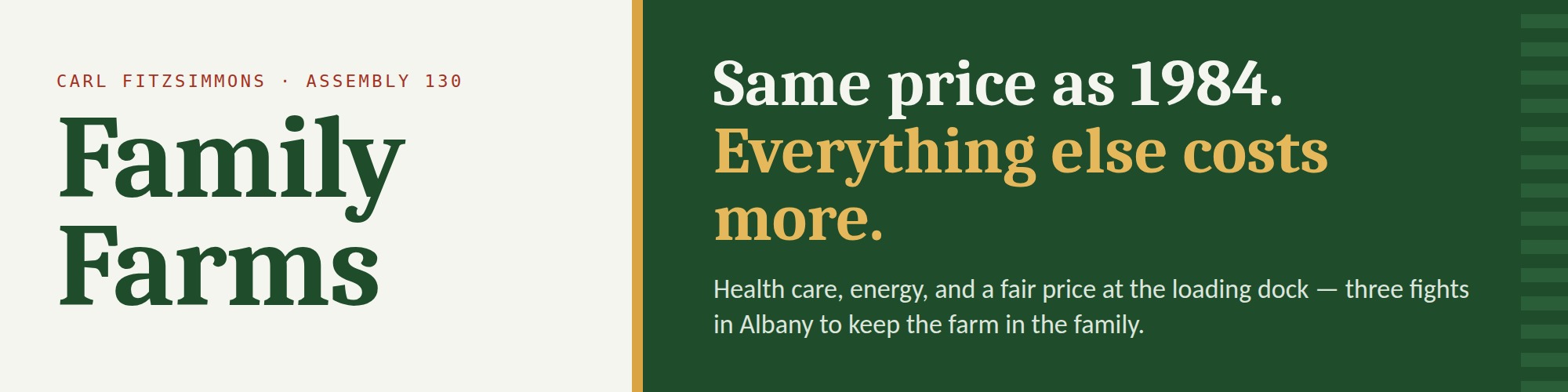
Health care, energy, and a fair price at the loading dock. Three fights in Albany, one goal: a family farm in Wayne County should be able to make a living selling what it grows — a young family should be able to start one without buying 200 acres, and every farmer should have the right to fix the equipment they paid for.
Same price as 1984. Everything else costs more.
In the Black Dirt onion country of Orange County, growers were getting $5.25 to $5.75 for a 50-pound bag of onions in 1984. In 2020 the offer was $7.00 a bag — about what it was forty years ago, while seed, fuel, labor, land, insurance, and equipment all went up. Adjusted for inflation, that 1984 price would be $13 to $14 today.
17¢ a pound to the farmer. 83¢ a pound on the ShopRite shelf. One Black Dirt grower did the math himself: the family that grew the onion keeps about a fifth of what you paid for it.
Chris Pawelski's family farmed that dirt for a century. Prices fell from $28 a bag to $12 in a matter of weeks in the 2019–20 season, under the cost of production. In April 2020 the Pawelski farm shut down. This is not a story about one bad year. It is what the system is built to do.
The apple grower gets the same deal. The packer and the chain set the price.
New York is the second-largest apple state in the country, and Wayne County is its biggest apple county. Almost none of those apples are sold by the family that grew them. They go to a packer, who sells to a chain, and the price flows backward: the retailer decides what the apple will sell for, the packer takes its cut, and whatever is left is the grower’s “price.”
$40 → $26.50 a 40-pound box. That is what U.S. growers were getting for a traypack of apples in 2021 and what they were getting by the 2024–25 season — about 66 cents a pound, down a third in four years, while the wage rate growers must pay seasonal labor rose and labor alone now eats 60 to 70 percent of the wholesale price of a box.
The apple industry’s own trade association explains the mechanism in one sentence: supermarkets use core apple varieties as loss-leaders to bring shoppers in the door, and the cost of that discounting is “passed back down to the grower.” The chain runs the sale. The grower pays for it. USApple’s 2026 outlook calls the result what it is — negative margins in a year of full harvests.
An onion in Orange County, an apple in Sodus. Different crop, same structure: one seller at a time facing a buyer who does not have to negotiate.
Who keeps the other 84 cents?
The USDA's own numbers say a farm gets 15.9 cents of every dollar Americans spend on domestically produced food. Trucking, packing, and grocery margins take the rest — and those layers have been consolidating for decades.
Walmart's share of U.S. grocery sales — larger than Kroger and Costco combined.
New York farms, 95% family-owned, 75% under 200 acres — each one selling alone.
When a handful of buyers face thousands of individual farms, the buyer sets the price. Growers describe internet bidding systems that push wholesale prices down with no way to see what the buyer is paying anyone else, and no other buyer to turn to. The onion farmer does not negotiate. He is told.
That is not a free market. It is a market with one side missing. And the same playbook — get big enough that the people who supply you have no choice — is how a few giant companies came to sit between every producer and every customer, whether the product is an onion or a search result.
Federal produce law says the buyer has to pay you. It never says the buyer has to talk to you.
The Perishable Agricultural Commodities Act (PACA), a 1930 federal law run by USDA, licenses produce dealers, sets a code of fair business practice, and runs a trust so that a grower who ships onions eventually gets paid for them. That mattered in 1930 and it matters now.
But PACA governs whether you get paid, not what you get paid. Nothing in federal produce law requires a distributor or a chain to negotiate with the grower, to disclose the price it pays anyone else, or to buy from local farms at all. A buyer can post a take-it-or-leave-it number on a bidding screen and never pick up the phone — and with a perishable crop that sprouts in sixty days, "leave it" means dumping the harvest. In 2020 New York's own senators had to ask USDA for a "top-to-bottom review" of fruit and vegetable pricing because farmers cannot see the market they are selling into.
Albany cannot rewrite a federal statute. Albany can decide how New York's own money, contracts, and markets are run — and that is where the fight is.
Get the insurance company off the farm's books.
Farmers are self-employed. Most have no employer plan. More than 27% of agricultural workers buy coverage on the individual marketplace, against 6% of the country as a whole. When the enhanced federal subsidies expired on December 31, 2025, farm families' premiums doubled, tripled, and in some cases quadrupled in a single renewal.
59% of farm and ranch families in a ten-state University of Vermont study got their health coverage through a public-sector job off the farm — a school, a hospital, a town. Somebody leaves the farm every morning so the farm can afford to exist.
The New York Health Act replaces premiums, deductibles, and networks with one public plan for every New Yorker. For a family farm that means no premium line in the budget, no spouse working off-farm to carry the coverage, and no medical bill that ends with selling land. The RAND analysis of the Act found similar or lower long-run costs for the state as a whole, assuming every federal waiver is granted. It also reduces what your school district and town pay for employee coverage, and every dollar of that comes straight off the property-tax levy — the same levy a farm pays on every acre.
Let the farm sell power the way it sells produce — except this time, at a fair price.
A farm has roofs, barns, ponds, manure, and open acres between the rows. Albany's rules today are written so that the utility owns the generation and the farm is a customer. My energy plan turns that around: locally owned public power — towns, schools, co-ops, municipal utilities like Fairport's — with NYPA as the builder and financier, not the owner.
- Remove the cap. State incentive rules size a solar system to 110% of your own past-year usage. Homes, farms, and schools should be allowed to produce well beyond their own needs and sell the surplus. That is a second or third income that does not depend on a grocery buyer's bidding screen.
- Renewable natural gas from dairy. Wayne County manure is fuel. Digesters turn a disposal cost into a product the farm sells.
- Solar canopies and small hydro where they fit — over equipment yards and parking, on existing mill sites — not carpeting prime cropland.
- Farm between the rows. Panels set high and spaced wide leave room to graze, keep bees, and grow underneath. That is how a young family gets a start — see below.
- Own the wires. Municipalization on the Massena model as a parallel track, so the rate a farm pays is set by neighbors, not by shareholders.
Cheaper power lowers the cost of cold storage, irrigation, and milking. Owning the power turns a cost into revenue. Both happen locally, and neither one goes through a middleman.
Give a young family a way to start farming without buying 200 acres.
The hardest part of starting a farm is not the work. It is the land. A young couple who grew up in Wayne County cannot buy 200 acres at today’s prices, so they leave. The county loses the family, the school loses the kids, and the farm down the road loses the next generation that would have taken it over.
Farming between the rows changes the math. Panels set high and spaced wide leave the ground underneath open. The shade cuts evaporation and heat stress on the crop. A community-owned solar array can lease that ground to a young family for a market farm, a berry patch, a flock of sheep, or a beeyard — a start on five acres, not two hundred, with the power sale paying the mortgage on the land.
Every one of those farms is a family that stays in Wayne County, kids in a Wayne County school, and a customer for the feed store, the equipment dealer, and the diner. That is what locally owned energy is for.
You paid $400,000 for the combine. You should be allowed to fix it.
A modern tractor or combine is a computer on wheels. When a sensor throws a fault code in the middle of harvest, the machine can shut itself down — and the software that clears the code, reprograms the part, or restarts the engine after an emissions lockout has been available only to the manufacturer’s authorized dealer. Not to the farmer who owns it. Not to the independent mechanic down the road. So the farm waits for the dealer’s truck, pays the dealer’s rate, and watches the crop stand in the field.
In January 2025 the Federal Trade Commission and five states sued Deere & Company for exactly this, charging that withholding the repair tool gave Deere monopoly power over the repair of its own equipment. In July 2026 Deere settled and agreed, for ten years, to give farmers and independent shops the same tools its dealers get: read and clear fault codes, reprogram parts, restart after an emissions shutdown, and read the manuals.
That is one company, under a ten-year consent order, because the federal government sued. It is not a right. New York passed the nation’s first Digital Fair Repair Act in 2022 — and carved farm equipment out of it. I will fight to put it back in, so every farm in the 130th can fix every machine it owns, with the manual, the parts, and the software, from whoever it chooses.
Fair prices for what farms sell. Fair costs for what farms buy. Keep the difference here.
Fair pricing is not a subsidy and it is not a price control. It is three plain principles, and Albany has the tools for every one of them.
- You can see the market. New York can publish what buyers are actually paying for New York produce, so a grower in Wayne County knows whether $7 a bag is the market or just the offer.
- You get a seat at the table. State-supported cooperative marketing so a thousand farms bargain as one, the way one buyer already bargains against a thousand farms.
- New York's money buys New York food. Schools, hospitals, prisons, and SUNY spend public dollars on food every day. Point those contracts at New York family farms first, at a price that covers the cost of growing it.
- Health care through the New York Health Act, so coverage is not a farm expense at all.
- Energy the farm owns instead of rents.
- Right to repair your own equipment, so a $200 sensor does not idle a $400,000 combine waiting for a dealer. Put farm equipment back in New York’s repair law.
- Local processing and distribution — nonprofit and cooperative packing, cold storage, and delivery — so the 84 cents that leaves the farm gate stays in Wayne County instead of Bentonville.
- Nonprofit hospitals reopened in Newark and on the Myers campus, because a farm community needs somewhere to go when the tractor rolls.
Vote November 3. Bring the farm with you.
Every dollar from $5 to $250 is matched by New York's public campaign finance program — up to 12 to 1. A $20 gift becomes $260 of outreach to voters in Webster and Wayne County, with no corporate money attached.
Volunteer: friends@friendsofbutch.com · call or text 585-746-9235
A source behind every claim.
- Sen. Gillibrand, press release, Feb. 6, 2020 — 1984 onion prices of $5.25–$5.75 per 50-lb bag ($13–$14 in today's dollars) vs. a $7.00 offer in 2020. gillibrand.senate.gov
- Civil Eats, Feb. 7, 2020 — Pawelski's 17¢/lb vs. 83¢/lb at ShopRite; $28 to $12 a bag; internet bidding and lack of price transparency; the Senate request for a USDA review. civileats.com
- Spectrum News, Apr. 3, 2020 — Pawelski farm closes after 100 years. spectrumlocalnews.com
- USDA Economic Research Service — farm share of the food dollar, 15.9 cents (2023). ers.usda.gov
- Grocery Dive / Numerator, 12 months ending June 30, 2025 — Walmart 21% of U.S. grocery, Kroger 8.5%, Costco 8.4%, Albertsons 4.9%. grocerydive.com
- USDA Agricultural Marketing Service — what PACA does: licensing, fair-practice code, dispute resolution, the PACA trust. ams.usda.gov
- NYS Comptroller, A Profile of Agriculture in New York State, Nov. 2024 — 30,650 farms (−8.3% since 2017), 94.6% family-owned, 75% under 200 acres; Wayne County 863 farms, $381.5M sales, 3rd in the state. osc.ny.gov
- KFF Health News, Jan. 22, 2026 — 27% of agricultural workers on the individual marketplace vs. 6% nationally; premiums after the Dec. 31, 2025 subsidy expiration. kffhealthnews.org
- University of Vermont / NORC, national farm health-insurance survey (1,062 farmers, 10 states) — 59% covered through an off-farm public-sector job; 73% call affordable coverage important to reducing business risk; 45% fear selling farm assets to pay medical costs. norc.org
- USApple / FreshFruitPortal, Aug. 24, 2026 — grower price per 40-lb traypack from ~$40 to under $29 over three years, then ~$26.50 in 2024–25; retail loss-leader discounting “passed back down to the grower”; negative margins; New York ~30.5 million bushels. freshfruitportal.com
- Fruit Growers News, May 2026 — wholesale apple prices down 23% from the 2023–24 peak; H-2A labor now 60–70% of the wholesale price per box (40% in 2013); growers losing money on the crop. fruitgrowersnews.com
- Federal Trade Commission, Jan. 15, 2025 — FTC and states sue Deere & Company over repair restrictions. ftc.gov
- Federal Trade Commission, July 8, 2026 — Deere settlement: ten years of dealer-equivalent repair tools for farmers and independent shops (fault codes, reprogramming, emissions restarts, manuals); Illinois, Arizona, Michigan, Minnesota, Wisconsin co-plaintiffs. ftc.gov
- U.S. Department of Energy, Solar Energy Technologies Office — agrivoltaics: crops and grazing under panels, commercial sites in Colorado, Massachusetts, and Maine, a 200 MW New Jersey pilot, more than 2.8 GW operating nationally, reduced evaporation and irrigation needs. energy.gov
- Sustainable CUNY, NYS Net Metering FAQ — NYSERDA incentives limited to systems sized at 110% of the prior 12 months' usage. nysolarmap.com
- Campaign briefs: Follow the Health Care Money (New York Health Act, RAND analysis) and the distributed energy plan.
READY TO MAKE A DIFFERENCE?
Join the campaign and help bring citizen-focused leadership to District 130.