

Where our health care money actually goes
Research by Carl Fitzsimmons with references
What the 130th could gain by keeping it here.
A family health plan on average costs $27,000 a year, a third of every dollar goes to billing and insurance overhead instead of care, and the insurers collecting it posted record profits while Wayne County lost its last birthing center.
The New York Health Act puts every New Yorker in one plan — no premiums, no deductibles, no copays, every doctor, and any hospital would be in your network (no out of network restrictions).
RAND found that nine in ten households would pay less under the plan — and every dollar it takes off your school district’s or town’s health-care bill can mean a dollar less pressure on your property taxes.
Each dollar it takes off comes off your school district’s and town’s health bill coming straight off your property tax.
Every figure below is footnoted to a public source. Read it, check it, and share it.
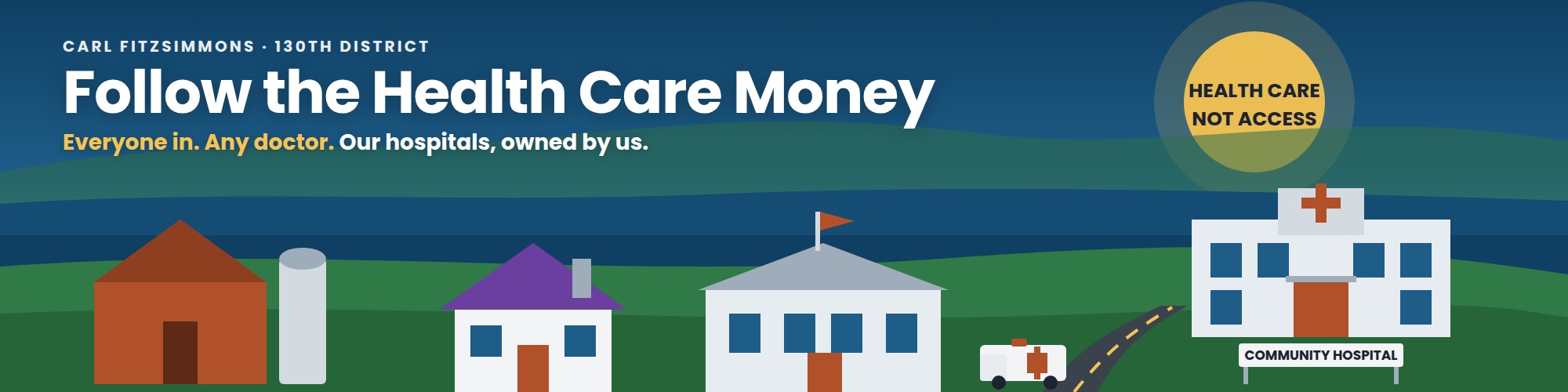
Follow the Health Care Money
A family health plan now costs about $27,000 a year and a third of every health care dollar goes to paperwork, not care. The insurers that collect it posted record profits while Wayne County lost its last birthing center. Here is where the money goes, what the New York Health Act would do with it instead, what RAND found when it checked, and how we bring our hospitals back — owned by us.
The average family plan through work cost $26,993 last year, up 6% while wages rose 4%.1 UnitedHealth alone made $12 billion in profit in 2025 and paid its CEO $61 million; five national insurers spent about $25 billion buying back their own stock and paying dividends.2 3 4 5 6 Excellus, the insurer most of the 130th uses, paid $408 million in administrative costs and $15 million to its top ten executives, and its rates go up again in 2027.7 8 Roughly 34 cents of every U.S. health care dollar is spent on billing, insurance and administration — about $812 billion a year — against about 2 cents on the dollar for Medicare.9 10
The New York Health Act puts every New Yorker in one plan with no premiums, no deductibles and no copays, paid for by a graduated payroll tax the employer mostly covers. RAND — hired by an independent foundation, not by the campaign — found total spending would be about the same at the start and 3% lower by 2031, that households below the 90th income percentile would pay on average $2,800 less per person, and that most employers would pay less than they do now. RAND assumed every federal waiver is granted; we say so before an opponent does.11 12 And because school districts and towns are employers too, every dollar it takes off their health bill comes straight off the property-tax levy.13 14
1. The premium ledger: where last year's money went
Every dollar of premium you, your employer, your school district or your town pays goes first to an insurance company. Here is what the six largest did with it in 2025, from their own annual reports.
| Insurer | 2025 revenue | 2025 profit | Returned to shareholders | CEO pay, 2025 |
|---|---|---|---|---|
| UnitedHealth Group2 3 | $447.6B | $12.06B | $5.5B buybacks + $7.9B dividends | $60.9M |
| Cigna6 3 | $274.9B | $6.0B | $3.6B buybacks + dividends | $22.9M |
| Elevance (Anthem Blue Cross)4 3 | $197.6B | ≈$5.7B | $4.1B | $22.6M |
| CVS Health / Aetna5 3 | $402.1B | $1.77B | $3.4B dividends | $21.2M |
| Humana15 3 | $129.7B | ≈$1.2B | — | $18.8M |
| Centene (Fidelis Care in NY)16 3 | $194.8B | $1.03B adjusted (GAAP loss on a $6.7B write-down) | $475M buybacks | $19.5M |
| First half of 2026 alone: UnitedHealth $11.8B, CVS $5.9B, Centene $3.05B, Humana $1.8B — all up on a year earlier17 18 | ||||
The pay ratios are the part to remember: in 2024 Elevance paid its CEO 370 times its median worker, UnitedHealth 348 times.19 Under federal law an insurer may keep up to 20 cents of every premium dollar in the individual and small-group markets (15 cents for large groups) for administration, marketing and profit before a rebate is owed.20
Closer to home: Excellus
Excellus is a nonprofit, and it did lose money on operations in 2025 — $108 million — because claims rose 16%, the biggest jump in nearly twenty years, with prescription-drug claims up 35%.21 That is the honest picture: even the nonprofit insurer in our market is a $7.5-billion-a-year toll booth whose costs are set by drug companies and hospital systems it cannot control, so the bill lands on you. Its 2026 individual rates rose 20.7% and small-group rates 15%; for 2027 the state approved another 12.2% and 13.5%.22 8 Statewide, insurers asked for 20.6% and 23.7% increases for 2027; regulators cut them to 6.0% and 8.0% and held the profit line to one percent — which tells you how much room was in the request.23 24
2. The paperwork: the cost of having 900 insurers instead of one
The paperwork is not an accident; it is the product. Every insurer has its own forms, networks, formularies and prior-authorization rules, and every hospital and doctor's office hires people to fight them. Medicare Advantage plans handled 53 million prior-authorization requests in 2024 and denied 4.1 million; only 11.5% of denials were appealed, and 81% of those appeals won — meaning most denials were wrong, and most patients never found out.27 In 2025 the denial rate on standard requests was 12% in Medicare Advantage, 14% in Medicaid managed care and 18% in marketplace plans, with two-thirds overturned on appeal.28 A federal inspector general found that 13% of Medicare Advantage denials were for care that met Medicare's own rules.29 New York hospitals report more than $3 billion in insurer denials outstanding.30
A denial is the purest form of cost externalization: the insurer keeps the premium and makes someone else — you, the hospital, the county — pay for what it did not want to cover. Privatized gains, socialized losses, one claim at a time.
3. What we pay in New York — and what just got worse
Coverage is going the wrong way. The federal budget law passed in July 2025 cut Medicaid and marketplace funding; the Governor's office projected 1.5 million New Yorkers would become uninsured and hospitals would lose $8 billion a year (the Empire Center argues the state's headline figure was partly double-counted and the first-year budget hit is closer to $2.6 billion — the coverage losses are not in dispute).33 34 On July 1, 2026 about 450,000 New Yorkers lost Essential Plan eligibility; replacement coverage runs about $250 a month with a $2,500 deductible.31 35 The enhanced federal premium credits expired at the end of 2025, and 50,000 fewer New Yorkers are getting help with premiums this year.36 37
Even for the insured, the plan is thinner every year: nationally 23% of working-age adults are underinsured — covered, but with deductibles they cannot afford — and 30% are paying off medical debt.38 New York has done more than any state to stop hospitals from suing patients (lawsuits fell from 13,886 in 2019 to 105 in 2025) and to keep medical debt off credit reports; that is worth celebrating, and it does not lower a single premium.39 40 41 Medical bills are GoFundMe's most common fundraiser, and the average campaign raises about 40% of what it asks.42 A GoFundMe is the market's answer to a denied claim.
In Wayne County the numbers are these: 91,250 people, nearly a quarter over 65, median household income $74,506, about 6.8% uninsured, one in five on Medicaid.43 44 45 A family plan at $27,000 is more than a third of that median income.
4. The market has spoken: what it said to Wayne County
Wayne County once had four hospitals. The state's own list of closed hospitals records one on Lake Avenue in Wolcott and the Lyons Community Hospital — both gone so long ago that the Health Department has "no information available" on where their records went.46 Sodus had Myers: opened in 1900 by Dr. John F. Myers, sold in 1955 to a nonprofit membership corporation, the Myers Community Hospital Foundation, and moved to a new building on Middle Road that the community paid for.47 By the 1990s a small nonprofit hospital could not survive on its own: grants were harder to get and insurers paid less for a small population. In 1998 Myers joined ViaHealth, the Rochester system that already owned Newark-Wayne.48 In November 2002 ViaHealth announced the closure — Myers was down to six inpatient beds and one admission a day, the system had absorbed $9.2 million in losses over five years, and its 80 staff would be "reassigned"; a ViaHealth administrator said it would "work with local real estate developers to market the Myers Hospital building."49 ViaHealth became Rochester General Health System in 2008 and Rochester Regional Health in 2014.48 The Sodus campus today is an outpatient site.50
Newark is following the same script. Newark-Wayne Community Hospital, opened in 1921 and part of the Rochester system since 1991, is the county's last hospital: 1,500 jobs, $68 million in payroll, 5,100 admissions and 24,000 emergency visits a year, and 78% of its patients on Medicare or Medicaid.51 48 In January 2025 it took six medical-surgical beds offline and told the county it had "no plans to close."52 In May 2026 Rochester Regional announced it would close the Marshall Birthing Center — more than seventy years old — sending deliveries to Rochester General.53 54 Births had fallen from 670 in 2019 to 380 in 2025; 37 staff were affected; the stated reason was recruiting physicians, "not a financial issue."55 56 The entire Wayne County Board of Supervisors and Senator Helming wrote to the Governor; fifty people came to the state hearing; the Health Department approved it anyway. The last baby was delivered August 31 and the unit closed September 3, 2026.57 58 59 A week later the same executive listed the real pressures on rural hospitals: "low reimbursements, staffing difficulties, aging populations, declining birth rates and falling inpatient volumes."60 Low reimbursement is a money problem. Residents at the September meeting asked the obvious next question: is the emergency room next?61
This is what "the market has spoken" means in a rural county. More than fifty New York hospitals have closed since 1996; 116 rural hospitals nationally have stopped delivering babies since the end of 2020, and only 41% still do.64 65 A market pays for volume; a county of 91,000 people spread over 600 square miles does not produce volume. So the market closes the small hospital, keeps the specialists in the city, and hands the drive to the mother in labor. Every closure is cost externalization — the system's loss becomes the family's gas money, missed work and risk — and every one leaves the very rich untouched, because they were never going to deliver in Newark anyway. Privatized gains, socialized losses.
5. What the New York Health Act actually does
The New York Health Act — A.1466 in the Assembly, S.3425 in the Senate — has been introduced every session since 1991 and passed the Assembly five times, most recently in 2018. Since the Senate changed hands in 2019 it has not left committee in either house; leadership has not brought it to the floor.66 67 68 69 What the bill text says it does:13
- Everyone covered. "Comprehensive health coverage to every member" — every New York resident — including everything Medicare, Medicaid, Child Health Plus and the ACA cover today.
- No premiums, no deductibles, no copays at the point of care.
- Any doctor, any hospital in the plan — there are no networks to be out of.
- Long-term care included since the 2019 amendments — home care and nursing care, "a major step forward for older adults, people with disabilities, and their families."
- Dental, vision, hearing and prescriptions covered.
- Public employees and retirees keep benefits at least as good as their contracts, and public employers pay at least 80% of the payroll tax (2023 amendments).70
- A graduated payroll tax: "the employer shall pay eighty percent of the payroll tax and the employee shall pay twenty percent," and the employer may pick up more.
- The first $25,000 of income is exempt ($50,000 for people on Medicare).
- A graduated tax on non-wage income (capital gains, dividends, interest) so the wealthy pay on what they actually earn.
- All the federal money New York already gets for Medicare, Medicaid and the ACA, pooled under federal waivers.
- It ends the county Medicaid share: "ending the requirement for local social services districts to pay part of the cost of Medicaid" — the $7.6 billion a year counties and New York City raise mostly from property tax.71
- The rates are set in a separate revenue bill the Legislature must pass before anyone enrolls — an honest gap opponents are right to point at, and one an Assembly majority can close.
What you stop paying: the $6,850 from your paycheck, the employer's $20,000 you never saw, the deductible, the copay, the bill for the out-of-network anesthesiologist, the county's Medicaid share on your tax bill, and the 20 cents on the dollar the insurer kept. What replaces it is one tax you can see on one line, that goes up with income instead of with age or illness.
6. What RAND found — and what it assumed
In 2018 the New York State Health Foundation hired the RAND Corporation — a research institution founded to advise the Air Force, not a health care advocacy group — to model the New York Health Act. RAND ran the numbers for 2022 and 2031 against the status quo.11 72 Its headline: "a single-payer plan in New York does not have to increase the amount of money spent overall on health care in the state, but it would substantially change who pays for health care."73
That is where "nine in ten" comes from: RAND found that households below the 90th percentile — roughly nine of every ten New Yorkers — would pay less on average, households in the 90th-to-95th percentile about $1,700 more per person, and the top 5% substantially more.12 Rivera and Gottfried's summary of the same study put the net employment effect at about 150,000 more jobs and the annual saving at $15 billion by 2031.74 The Campaign for New York Health rounds it to "over 90% spend less"; a 2015 study by UMass economist Gerald Friedman said 98% — that figure is Friedman's, not RAND's, and this brief uses RAND's.75 76
What RAND assumed — say it first
RAND's estimate depends on three assumptions, and an honest campaign states them before an opponent does. First, every federal waiver is granted: "Key assumptions of our modeling analysis include the following: Federal waivers for Medicaid, Medicare, and ACA requirements are approved."12 Without waivers, federal Medicare and Medicaid money keeps flowing through federal programs and the state plan wraps around them — still possible, but a different bill. Second, administration costs 6% of spending — three times Medicare's rate, half the private insurers' — and provider payments grow at the public-program rate. Third, nobody moves: RAND warns that "even a small tax migration or avoidance effect could influence the state's ability to finance the program." RAND's own range runs from 15% lower spending (if drug prices reach Medicaid levels and administration is lean) to 12% higher (if provider rates and administration both run high).12 The taxes are large because they replace premiums: about $139 billion in new state revenue in 2022, rising to $210 billion — money households and employers are already spending on premiums, deductibles and copays, collected differently.12
The critics' numbers, so you have them: the Empire Center says 31% of New Yorkers would pay more, mostly people on Medicaid or the Essential Plan who pay nothing today and would owe a small payroll tax; the Business Council calls it "the largest tax increase in New York history"; the insurer-funded Realities of Single Payer coalition says "$250 billion in new taxes" and "160,000 lost jobs."77 78 72 79 Every one of those numbers is a way of describing the same thing RAND described: the premium becomes a tax, and the people who pay more are the ones with the most.
7. The property-tax connection
Here is the part of the health care money that shows up in an envelope from the town every January. New York's school districts spend about $7 billion a year on health insurance for employees, their families and retirees — $6,813 per pupil in benefits against $3,143 nationally — and it has been the fastest-growing line in the school budget for two decades.14 Towns, villages and the county pay the same premiums for highway crews, clerks and deputies, and carry hundreds of billions in promised retiree coverage statewide that no one has funded.80 On top of that, Wayne County sends its share of Medicaid to Albany every year — the local share averages 8.6% of county budgets outside New York City — and that money comes almost entirely from the property tax.81 71
The New York Health Act reduces what your school district and town pay for employee health coverage, and every dollar of that comes straight off the property-tax levy. Under the bill a public employer stops paying premiums and pays the payroll tax instead; RAND found employers that offer coverage today would pay $200 to $800 less per worker, and the New York City Comptroller estimated the City could spend about $3 billion less a year on active-employee coverage.12 82 The county Medicaid share ends outright.13 This brief does not put a percentage on your school levy, because the honest number depends on the tax rates the Legislature sets in the revenue bill and on each district's contract. What is not in doubt is the direction: the health line in the school budget goes down, the county's Medicaid line goes to zero, and the levy follows.
8. Who is for it: the people who deliver the care and bargain for the coverage
The nurses' union, NYSNA, "strongly advocates" the New York Health Act and sent members to Albany for it again in May 2026; its president, Nancy Hagans: "I have seen patients suffer because they didn't have health insurance … It's time to pass the New York Health Act!"83 84 1199SEIU, the health care workers' union, CWA, RWDSU and the Doctors Council SEIU support it.70 85 The United Auto Workers' 2026 statement of its issues says: "Our union has always maintained that health care must be a human right, not simply a privilege for the wealthy." "We need a single-payer system that guarantees quality, comprehensive health care for all and that puts patients above profits."86 The UAW's New York region put "passing the NY Health Act" on its state legislative agenda, and the UAW International is an endorsing organization of Medicare for All in Congress alongside SEIU, the National Education Association, National Nurses United and the Mine Workers.87 88
Why would a union that already bargains good coverage want this? Because every contract fight for twenty years has been a fight over health care: the raise that went to the premium instead of the paycheck, the strike over the deductible, the plant that moved to a country where the employer does not carry the health bill. The UAW's case is that single payer is good for its members and good for their communities — the laid-off worker, the retiree, the neighbor with no union — because the cost stops following the job. Not every union agrees: NYSUT and DC 37 withdrew their support in 2023 over whether members would keep contract-quality benefits, the UFT wants financial assurances, and the building trades have been wary; the 2023 amendments guaranteeing public employees benefits at least as good as their contracts were written to answer them.70 85 89 That is the work of coalition, and it is not finished.
9. Who really took the money — and the objections you will hear
We were told the immigrant took your health care, the family on Medicaid, the guy who won't work. Look at the receipts. The federal law that pushed 450,000 New Yorkers off the Essential Plan this July was sold as cutting coverage for "illegals"; the people who lost it were lawfully present — green-card holders, refugees, people here on work visas who pay the same taxes you do.33 31 In the same year, UnitedHealth made $12 billion, its CEO $61 million, and the six national insurers together spent $25 billion on buybacks and dividends.2 3 6 The health insurers' trade association spent $17.2 million lobbying Washington in 2025, UnitedHealth another $12.5 million; in Albany, the hospital association was the fourth-largest lobbying client at $3.1 million and gave $942,000 to the Governor's last campaign.90 91 92 93 The coalition running the ads against the New York Health Act — "Realities of Single Payer" — is the Health Plan Association, the Blue Cross conference, the Business Council and the chambers of commerce, including Rochester's.94 Nobody on Medicaid wrote a lobbying check. This is not about capitalism; a farmer selling apples is a capitalist. It is about a specific industry that collects a toll on care and spends part of it making sure the toll stays. The gains are privatized; the losses — the denied claim, the closed birthing center, the GoFundMe — are socialized.
It is one public fund paying private doctors and nonprofit hospitals — the same arrangement as Medicare, which nearly every Wayne County resident over 65 already uses and would not give back. What we have now is the market privatizing the gains and socializing the losses: the insurer keeps the premium, and when it denies the claim or the hospital closes the ward, the cost lands on the family, the county and the emergency room. Ask which one is the handout.
It is the biggest premium cut in history, collected as a tax. RAND put the new state revenue at $139 billion in 2022 rising to $210 billion — replacing the premiums, deductibles and copays New Yorkers already pay — and found total spending about the same, then 3% lower. The $250 billion figure adds a long-term-care estimate to RAND's number; RAND's long-term-care scenario found spending 2% above the status quo, not $40 billion more.12 95 A tax you can see on one line replaces a premium you cannot see at all — the $20,000 your employer pays is your money.
You lose the insurance company. You keep your doctor and your hospital — every one of them is in the plan — and you lose the premium, the deductible, the copay and the network. What people fear losing is a good union plan; the 2023 amendments guarantee public employees benefits at least as good as their contracts.70
Vermont's governor dropped the plan in 2014 before a vote because his tax numbers came in high and his state has about 640,000 people — too few to carry a system alone.96 New York has 20 million, more than most countries that run single payer. Canadians wait for elective specialty care and do not wait for a bill they cannot pay; 30% of working-age Americans are paying off medical debt now.38 The waiting list we have today is called a prior-authorization denial.28
Five percent of 20 million is a million people; 23% of the insured are underinsured with deductibles they cannot meet; and 450,000 lost their plan this July. Coverage that does not cover is the problem the bill is written for.38 31 97
Then federal money keeps flowing through Medicare and Medicaid as it does today and the state plan wraps around them — a harder, more expensive version, which is why we say up front that RAND assumed the waivers. The answer is to build the plan, seek the waivers, and have the transition written in the revenue bill — not to keep paying $27,000 a family while we wait.12
10. Bring the hospitals back — owned by us
The market closed Myers and is closing Newark one unit at a time. The answer is the one Sodus found in 1955: a nonprofit the community owns. The path is for local nonprofits — a hospital foundation, a federally qualified health center, a cooperative of the towns — to buy Newark-Wayne from Rochester Regional and buy back the Myers campus, and reopen them as community hospitals sized for what a rural county actually needs: a birthing center, an emergency room that stays open, urgent care, primary care, rehabilitation and long-term care, with specialists visiting from the city instead of patients driving to it. Carl Fitzsimmons will work with whatever local groups decide this is what they will do for our communities, and put the state's money and law behind them.
It has been done. In Troy, a year-long community campaign and $5 million in state funding got Trinity Health to reverse the closure of the Burdett Birth Center — with a Democratic Assemblymember and Republican county officials on the same side.98 In Madera, California, a hospital that closed in 2022 reopened in 2025 with a $57 million state distressed-hospital loan and 497 employees.99 In Martin County, North Carolina, the county is reopening its closed hospital as a federal Rural Emergency Hospital.100 Cuba Memorial in Allegany County was ten days from closing, converted to critical-access status, restructured its debt and is still open.101 And Clifton-Fine Hospital in St. Lawrence County is pursuing the federal Rural Emergency Hospital designation — a model New York allows — that pays a hospital a fixed monthly federal payment to keep an emergency room and outpatient services open without inpatient beds.102
The money exists. New York's Statewide Health Care Facility Transformation Program put out nearly $300 million in its latest round; the federal Rural Health Transformation Program is sending New York more than $212 million in its first year and just awarded $76 million to 56 rural organizations; USDA Community Facilities loans finance rural hospitals directly; and Senator Helming's bill to pay critical-access hospitals 101% of cost is sitting in committee waiting for an Assembly partner.103 104 105 106 The honest caveats: Myers closed with six beds and one admission a day, so a reopened Sodus is a birthing center, urgent care and rehabilitation campus, not a 1955 hospital; Massena's town took on $9.3 million in pension liabilities when it handed its hospital to a system, so the deal terms matter; and none of it is stable on today's reimbursement — which is why the hospital plan and the New York Health Act are one plan.49 107 A single public payer that pays one adequate rate for a delivery in Newark is what keeps the lights on in Newark.
Pass the New York Health Act: every New Yorker in one plan, no premiums, no deductibles, no copays, any doctor, any hospital, long-term care included, with the school district's and the town's health bill coming off your property tax. Say plainly what RAND assumed and write the transition into the revenue bill. Keep Newark-Wayne whole and bring back a birthing center in Wayne County — by state funding as in Troy, by a Rural Emergency Hospital license if that is what keeps the doors open, and by backing any local nonprofit that decides to buy Newark and reopen Sodus. Take no money from insurers or hospital systems. Follow the money — then bring it home.
The work in Albany — street power, people power, electoral power
| What has to happen | In Albany (Butch) | In the district (you) |
|---|---|---|
| Pass the New York Health Act | Co-sponsor A.1466 on day one; seek a seat on the Health Committee; press the Speaker for a committee vote and a floor vote in the first session; carry the revenue bill so the tax rates are public and the waiver transition is written down; hold a Health Committee hearing in Wayne County. | Town board, school board and county resolutions in support (with the property-tax line in them); the Campaign for New York Health's district chapter; nurses, autoworkers and health care workers at the hearing; a postcard from every family with a $27,000 plan. |
| Keep Newark-Wayne open, bring back births | State funding on the Troy model for a Wayne County birthing center; DOH conditions on any further service cut at Newark-Wayne; co-sponsor the critical-access 101% bill in the Assembly; a Rural Emergency Hospital pathway in state law; Rural Health Transformation dollars steered to the 130th. | The Board of Supervisors' letter becomes a standing county hospital commission; a Wayne County hospital foundation or cooperative of towns forms to be the buyer; pack the next DOH hearing before the next unit closes. |
| Reopen Sodus, community-owned | Capital money from the Facility Transformation Program and USDA for a nonprofit buyer; a state right of first refusal for community nonprofits when a system closes or sells a rural hospital; NYPA-style low-cost financing for community health facilities. | Sodus, Williamson, Wolcott and the lakeshore towns decide what they need — a birthing center, urgent care, rehab — and the nonprofit is built to that; the Myers Foundation's 1955 model is the blueprint. |
| Stop the bleeding now | State backfill for the 450,000 who lost the Essential Plan; a state premium credit to replace the expired federal one; prior-authorization limits and a 48-hour turnaround for urgent care; public reporting of every insurer's denial and overturn rates. | Sign-up drives for the people who lost coverage in July; document every denial — the overturn rate is the evidence. |
| Keep it honest | Refuse insurer and hospital-system money; publish every meeting with an insurer, system or lobbyist; an annual public report on where the health care money went. | Follow the money at the door: when someone says the immigrant took it, show them the receipts. |
Street power gets the county resolution and the hearing. People power builds the coalition — nurses, autoworkers, school boards, mothers who drove to Rochester in a snowstorm — that outlasts one session. Electoral power puts a vote in the Assembly that an insurer cannot buy. Together, we can get this on the Governor's desk the first year.
Sources
- KFF Employer Health Benefits Survey, Oct 22 2025 — family premium $26,993; worker share $6,850; up 6% vs 2.7% inflation and 4% wages
- UnitedHealth Group 2025 results, Jan 27 2026 — revenue $447.6B; net earnings $12.06B; buybacks $5.5B; dividends $7.9B
- Becker's, Apr 22 2026 — highest-paid payer CEOs, 2025
- Elevance Health Q4/FY2025, Jan 28 2026; Becker's: "nearly a $5.7 billion profit"; $4.1B returned to shareholders
- CVS Health FY2025 results — revenue $402.1B; net income $1.77B; dividends $3.4B; Aetna revenue $143.4B
- The Cigna Group FY2025, Feb 5 2026 — revenue $274.9B; shareholders' net income $6.0B; $3.6B buybacks
- Finger Lakes Times, Mar 16 2026 — Excellus 2025: $7.5B premiums, $408M administrative costs, CEO $4.4M, top ten executives $15M
- FingerLakes1, Sept 4 2026 — Excellus 2027 approved: 12.2% individual, 13.5% small group
- Himmelstein & Woolhandler, Annals of Internal Medicine, Jan 2020 (via EurekAlert) — $812B, 34.2% of spending, 2017
- Congressional Budget Office, Working Paper 2020-08, Dec 2020 — administration ≈2% of Medicare fee-for-service vs 12% for private insurers
- RAND Corporation, "An Assessment of the New York Health Act" (RR-2424), Aug 1 2018 — Liu et al.
- RAND RR-2424 full report (PDF) — Summary pp. xi–xiii, key assumptions, Table S.2
- S.3425 bill text (PDF) — coverage, payroll tax 80/20, $25,000 exemption, ending the local Medicaid share, federal waivers
- Citizens Budget Commission, "A Premium Option," Feb 22 2021 — NY school districts spend $7B/yr on employee and retiree health insurance; $6,813 per pupil in benefits vs $3,143 nationally
- Becker's, Feb 11 2026 — Humana 2025 net income nearly $1.2B on $129.7B revenue
- Centene FY2025, Feb 6 2026 — revenue $194.8B; adjusted net earnings $1.03B (GAAP loss on a $6.7B goodwill write-down)
- Fierce Healthcare, Aug 7 2026 — first-half 2026 profits: UnitedHealth $11.8B, CVS $5.9B, Centene $3.05B
- Becker's, Aug 5 2026 — Q2 2026 insurer profits ranked
- Becker's, Apr 22 2025 — CEO-to-worker pay ratios, 2024: Elevance 370:1, UnitedHealth 348:1
- KFF, July 13 2026 — medical loss ratio rules (80% / 85%) and 2026 rebates
- Rochester Business Journal, Mar 3 2026 — Excellus 2025: $108M operating loss, $150M net income, $1.7B reserves, claims up 16%
- CNY Central — Excellus 2026 approved increases: 20.7% individual, 15% small group
- NYS DFS, Sept 4 2026 — 2027 rates: individual requested 20.6%, approved 6.0%; small group requested 23.7%, approved 8.0%
- NYS DFS, Aug 29 2025 — 2026 rates: insurers asked 13.2% / 23.6%; profit provision held to 1.0%
- Shrank et al., JAMA, Oct 2019 — waste $760–935B; administrative complexity $265.6B
- Himmelstein et al., Health Affairs, Sept 2014 (Commonwealth Fund) — hospital administration 25% of U.S. hospital spending
- KFF, Jan 28 2026 — 53M Medicare Advantage prior-auth requests in 2024; 4.1M denied; 11.5% appealed; 80.7% of appeals overturned
- KFF, Aug 13 2026 — 2025 denial rates: Medicare Advantage 12%, Medicaid managed care 14%, marketplace 18%; 67% overturned on appeal
- HHS Office of Inspector General, Apr 2022 — 13% of Medicare Advantage prior-authorization denials met Medicare coverage rules
- HANYS fiscal survey, Nov 2025 — 30% of NY hospitals project negative margins; median margin 0.1%; insurer denials over $3B
- NYS DOH, Mar 23 2026 — 450,000 New Yorkers lose Essential Plan eligibility July 1 2026
- KFF, May 19 2026 — average net marketplace premium up 58% ($113 → $178/mo)
- Gov. Hochul, July 11 2025 — federal bill: 1.5M New Yorkers projected uninsured; ~730,000 lawfully present non-citizens lose Essential Plan; $8B/yr hospital cuts
- Empire Center — state Budget Division puts FY2027 cost at $2.6B; "$13 billion" figure partly double-counted
- Fiscal Policy Institute, Feb 12 2026 — regional impacts of the July 2026 Essential Plan cliff
- NY State of Health, Apr 21 2026 — 2026 coverage update: 50,000 fewer receiving financial help
- NYS DOH, Nov 6 2025 — expiring federal credits would raise premiums nearly 40% for 140,000 New Yorkers
- Commonwealth Fund biennial survey, Nov 21 2024 — 23% underinsured; 30% paying off medical debt
- Community Service Society, Oct 8 2025 — hospital lawsuits against patients fell from 13,886 (2019) to 105 (2025)
- Gov. Hochul, Dec 13 2023 — Fair Medical Debt Reporting Act signed
- Urban Institute, July 2023 — medical debt in New York; ~740,000 New Yorkers with medical debt on credit reports
- KFF Health News, Feb 12 2024 — medical is GoFundMe's most common category; campaigns average ~40% of goal
- U.S. Census QuickFacts — Wayne County, NY: population 91,250; 23.2% age 65+; median household income $74,506; 5.6% uninsured under 65
- NYS DOH county health indicators — Wayne County: 858 births/yr; 6.8% uninsured; 62.1% early prenatal care
- Data USA — Wayne County, NY: 19.7% of residents on Medicaid; uninsured 6.8% (2024)
- NYS DOH, "Where to find medical records for closed hospitals" — lists a closed hospital at Lake Ave., Wolcott, and Lyons Community Hospital, Wayne County
- Wayne County Historians — Myers Hospital, Sodus: founded 1900; sold to the nonprofit Myers Community Hospital Foundation in 1955
- Rochester Regional Health archives finding aid, 2018 — Newark-Wayne joined 1991; Myers joined 1998 (ViaHealth of Wayne); Myers closed 2003; ViaHealth → RGHS 2008 → RRH 2014
- Rochester Business Journal, Nov 14 2002 — "Myers Hospital in Sodus to close": six beds, one admission a day, $9.2M losses absorbed over five years, ~80 staff
- Rochester Regional Health — Sodus Medical Campus (outpatient) today
- HANYS economic-benefit report — Newark-Wayne: 1,500 jobs, $68M payroll, 400 babies delivered, 78% of admissions Medicare or Medicaid
- Finger Lakes Times, Jan 2025 — "Newark-Wayne officials stress hospital not closing"; Myers closed 2002
- Rochester Regional Health, May 2026 — planned closure of Newark-Wayne labor & delivery
- Rochester Business Journal, May 13 2026 — RRH to close labor and delivery at Newark-Wayne
- FingerLakes1, May 30 2026 — 670 births in 2019; Rochester General roughly 35 miles away; winter drives over 45 minutes
- 13WHAM, May 29 2026 — forum: births 502 (2021) → 380 (2025); 37 staff; "not a financial issue"
- Finger Lakes Times, May 28 2026 — entire Wayne County Board of Supervisors and Sen. Helming write to the Governor
- FingerLakes1, May 22 2026 — Sen. Helming presses the state to intervene
- FingerLakes1, Aug 26 2026 — DOH conditional approval; last deliveries Aug 31; suspension Sept 3 2026
- FingerLakes1, Sept 6 2026 — Rulffes cites "low reimbursements, staffing difficulties, aging populations, declining birth rates and falling inpatient volumes"
- Times of Wayne County, Sept 2026 — what's next at Newark-Wayne; RRH: no plans to close the hospital
- Rochester Regional Health, FY2024 audited statements (EMMA) — $3.85B revenue; $7.4M income from operations (0.19%); 105 days cash
- Rochester Regional Health parent, IRS Form 990, 2024 — CEO compensation $3.95M
- Community Service Society testimony, Oct 29 2024 — over 50 NY hospitals closed since 1996; beds 74,000 → 53,000
- Healthcare Dive, Nov 13 2025 — 116 rural hospitals ended obstetrics since end of 2020; only 41% of rural hospitals still deliver babies
- NYS Assembly A.1466 (2025–26), New York Health Act — sponsor Paulin; referred to Health Jan 9 2025 and Jan 7 2026
- NYS Senate S.3425 (2025–26), New York Health Act — sponsor Rivera
- New York Health Act — history: introduced 1991; passed Assembly 1992, 2015, 2016, 2017, 2018
- The Indypendent, July 29 2026 — bill has not left committee in either house since 2019
- Spectrum News, July 7 2023 — 2023 amendments: public employees, 80% employer share, long-term care; union positions
- NYS Association of Counties — counties and NYC pay $7.6B a year toward Medicaid, "larger than all other counties in the country combined"
- Times Union, Aug 1 2018 — study funded by the NYS Health Foundation; Business Council and Empire Center reactions
- RAND press release, Aug 1 2018 — Jodi Liu: "does not have to increase the amount of money spent overall … but it would substantially change who pays"
- Sen. Rivera / Asm. Gottfried release on the RAND study, Aug 1 2018 — ~150,000 net new jobs, $15B/yr saving by 2031
- Campaign for New York Health — FAQs
- Asm. Gottfried community update, June 2015 — Friedman economic analysis: 98% pay less, $45B net savings
- Empire Center, "Do No Harm," Jan 2019 — estimates 31% would pay more
- Empire Center, "Sticker Shock" — the case against, with its numbers
- Realities of Single Payer — "$250 Billion in New Taxes," "160,000 Lost Jobs"
- Empire Center, "Debt Iceberg," Nov 2021 — ~$360B in unfunded retiree health liabilities across NY public employers
- Citizens Budget Commission, Oct 1 2018 — local Medicaid share $7.6B/yr; averaged 8.6% of county budgets outside NYC
- NYC Comptroller, "Paying More, Getting Less," Dec 22 2025 — City could spend ~$3B less a year on active-employee coverage under NYHA
- NYSNA — single-payer campaign page; Nancy Hagans: "It's time to pass the New York Health Act!"
- NYSNA update, May 15 2026 — nurses lobby Albany for NYHA
- Work-Bites, Oct 3 2024 — Doctors Council SEIU support; UFT position
- UAW, "2026 Guide of Our Issues," Jan 2026, pp. 19–20 — "health care must be a human right"; "a single-payer system … that puts patients above profits"
- UAW Region 9A NYS political priorities, 2019 — "passing the NY Health Act"
- Medicare for All Act of 2023 endorsing organizations — UAW, SEIU, NEA, NNU, UE, UMWA, IATSE, AFA-CWA
- Substack, "NY got close to passing single payer" — 2021 Municipal Labor Committee objection, UFT coordination with Realities of Single Payer
- Payer Perspectives, May 1 2026 (federal lobbying disclosures) — AHIP $17.23M in 2025; UnitedHealth $12.54M
- City & State, June 12 2026 — Greater New York Hospital Association #4 client, $3.1M, for 280 hospitals
- New York Focus, Feb 29 2024 — GNYHA gave $942,000 to Hochul's 2022 campaign; $31.8M to federal races since 2016
- NYS Commission on Ethics and Lobbying, Apr 16 2026 — 2025 lobbying spending $384.5M
- Realities of Single Payer — member list (NY Health Plan Association, Blue Cross conference, Business Council, Greater Rochester Chamber, others)
- MACNY memo in opposition, Mar 14 2023 — "$250 billion"
- Wikipedia — Green Mountain Care: Gov. Shumlin abandoned Vermont's single-payer plan Dec 17 2014, citing "potential economic disruption"
- Business Council of NYS testimony, Nov 25 2019 — "a problem that does not exist"
- NPR, Sept 1 2026 — Troy, NY: community campaign and $5M in state funding reversed the closure of Burdett Birth Center
- Fresnoland, Mar 18 2025 — Madera Community Hospital reopened with a $57M state distressed-hospital loan
- WRAL, Sept 2025 — Martin General Hospital, NC: county-led effort to reopen as a Rural Emergency Hospital
- Tower Investments, 2005 — Cuba Memorial Hospital rescued: critical-access conversion, county grant, debt restructured
- Clifton-Fine Hospital — pursuing federal Rural Emergency Hospital designation in New York
- Gov. Hochul, Aug 8 2025 — ~$300M Statewide Health Care Facility Transformation Program round
- FingerLakes1, Sept 4 2026 — federal Rural Health Transformation Program: NY first-year allocation $212M+; $76.2M awarded to 56 organizations
- USDA Rural Development — Community Facilities Direct Loan & Grant Program
- S.3430 (Helming) — 101% cost reimbursement for critical access hospitals; in Senate Health Committee
- WWNY, July 2022 — Town of Massena still carrying $9.3M in hospital pension debt after the 2019 transfer
READY TO MAKE A DIFFERENCE?
Join the campaign and help bring citizen-focused leadership to District 130.
